
I originally defined historical images from the top down, as the examination of the big, complete picture divided into smaller components. In the middle ground image, these elements are separate but intertwined stories that have a similar internal structure and together form a coherent whole. I looked at this image from the outside, from above, to show why it is worth to consider. However, when we really want to adapt this approach to reality, it is essential to start from below and from within, from a systematic comparison of individual smaller elements. If we discover the individual similarities and parallels and build them on each other from the bottom up, then we will ultimately create the model that we initially aimed for from above.
Contents
Morphology in the living world
Such comparative studies are a fruitful and established practice in many scientific fields. Their common name is morphological analysis. Linguistic morphology studies the form and components of words, while in geography, for example, river meanders and sediment formation can be classified based on similar principles. Perhaps the most influential applications of the morphological method, however, are found in biology, closely related to the theory of evolution.
In the attached figure, I have outlined the “family tree” of selected animal species – the praying mantis, the gray wolf, the domestic cat, the bottlenose dolphin and the great white shark – according to the current state of science. This is the order of descent according to which the development of these species has branched out over time. This is a simplified diagram of their evolution. The diagram also shows the estimated time of each branching, as well as an indication of whether the ancestors of the species lived on land or in the water. It can be seen that of the five animal species, only the ancestors of the shark remained in the water throughout. The ancestors of the mantis took possession of the land first. The common ancestors of the wolf, cat, and dolphin did the same somewhat later – many millions of years later – but the cetaceans eventually returned to the sea, where they are still found today.
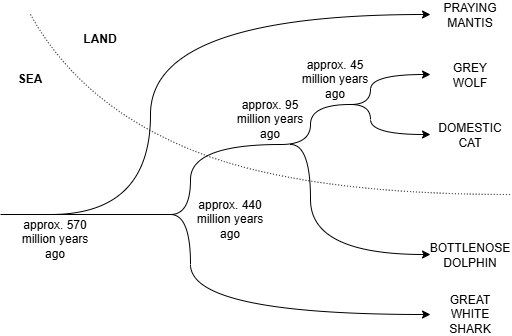
If we examine the limbs of these five species of animals, we will find that the limbs are clearly recognizable and adapted to a terrestrial or aquatic lifestyle. In short: terrestrial animals have legs, and marine animals have fins. In the case of the wolf and the mantis, the legs evolved independently of each other, since their common ancestor lived in the sea a very, very long time ago and certainly did not have legs. (This phenomenon is usually called convergent evolution.) The legs of the wolf and the mantis are analogous organs, they work similarly and have the same function. On the other hand, if we compare the wolf with the dolphin, we find that their common ancestor lived less long ago. It was a land animal with legs, and the dolphin’s fins evolved from these legs during their return to the sea (divergent evolution). The wolf’s legs and the dolphin’s fins are homologous organs of the same origin. We can also discover a third, simpler version in the diagram: the gray wolf and the domestic cat both retained the main features of the limbs of their common ancestor (parallel evolution). The properties of analogy and homology both apply to their legs.1
We can perform the same investigation about the animals’ respiratory systems. In that case, we will get a completely different result. The praying mantis, like other insects, has tracheal respiration, meaning a separate system of tubes transports oxygen from the air to its cells, completely independent of the circulation of body fluids. The shark breathes with gills, while the wolf, cat, and dolphin have lungs. There is no convergent evolutionary pattern among these species regarding respiration. First the grasshopper and then the shark took a divergent evolutionary path compared to the others, and the remaining three species have since followed a parallel path.
The morphological method thus shows that different organ systems of animal species can follow different evolutionary patterns. The process of evolution is often very complex and intricate, and we must be very careful before making any firm statements about it. It is also important to note that the two inspections led to fundamentally different results. In the case of the limbs, we saw that the results – the legs and fins – were determined by the habitat, lifestyle, and ecological niche of the species, almost independently of their kinship. Land animals have legs, aquatic animals have fins. In the case of respiration, on the other hand, it turned out that closer kinship means similar organs and organ systems, and even the very spectacular change in habitat and role – the return of cetaceans to the water – did not change this. On the contrary, the way they breathe limits what part of the ocean these animals can conquer.2
The conclusion of the whole analysis regarding the future is that we can separate those features that can be predicted well in advance (like the respiratory organs of an animal’s descendants) from those that are almost completely unknown (like the limbs of an animal’s descendants). We can therefore say that morphological analysis has led to the construction of a predictive model in biology. It is hoped herein that the same method will also be used to shape our middle-of-the-road view of history.
Morphology of human societies
Since human beings are part of the living world, the evolutionary model can be applied directly to them. The place of the human species could be drawn without much difficulty on the diagram just presented, and our breathing and limbs could be examined.3 However, here and now we are only interested in the last few thousand years of human history, primarily the period for which we have written sources. This period was too short for evolution to have changed the basic characteristics of the human race.
In order to use the evolutionary model to describe recorded human history, we need to make some modifications. As we saw in the small example, the usual studies in evolutionary morphology mostly concern the body structure and physiological characteristics of living beings; in contrast, we will use a similar method to analyze human social behavior, customs, and institutions. With this decision, we have also changed the subject of the study: instead of the entire human race, we are interested in selected communities in a much smaller timeframe.
Imagine, for example, two neighboring civilized countries – let us call them Berghengotia and Ghirgatia – that have been developing in parallel for many centuries! At the beginning of our story, in both places the economic inequality between the ruling elite and the common people is dangerously large, and political life is therefore tense and full of tension. (I think it is not particularly difficult for the modern Western world to imagine this situation.) Let us further assume that both countries are attacked by barbarians, Berghengotia by the Marakums, Ghirgatia by the Horokums!
In Berghengotia, a charismatic politician persuades the wealthy ruling class to arm the common people, and then defeats the Marakums in a bloody battle with this new army. The masses save Berghengotia. Upon returning from the war, the same politician exploits his success: using the threatening power of weapons, he forces a number of economic and political reforms that improve the living conditions of the masses at the expense of the aristocracy. Then, to ensure the achievements and the perpetuation of his own name, he transforms the Berghengotia constitution and takes the most important position of power.
The inhabitants of Ghirgatia react differently to the invasion of the barbarians. The elite, terrified of the common people, executes charismatic populist politicians and refuses to arm the masses. Instead, they fight with a smaller force of mercenaries and slaves, which is swept away by the Horokums. The vast majority of the population does not resist the invaders, and therefore the old Ghirgatian power structure is destroyed. The leader of the horde enters the capital, plunders the palaces, and sets them on fire. After that, he proclaims the creation of a new empire, of which he is the first ruler. The new empire is called the Khanate of Horokum, and among the first measures of the cunning barbarians are economic and political reforms that improve the living conditions of the masses at the expense of the survivors of the former ruling class.
Most history books would present these two stories as if the two countries had taken opposite paths. Berghengotia was victorious while Ghirgatia was destroyed. On the map, the red Berghengotia remains red while the blue Ghirgatia is recolored yellow. In comparison, if we look at the everyday life of the population, the culture and society, we find that the differences between the two cases are much less stark.
In both countries, a violent populist reform took place, transforming the political system and putting new leaders in charge. The two processes can be drawn into an analogy without further ado. The populist takeover in Berghengotia and the barbarian conquest in Ghirgatia ultimately took place for similar reasons and played a similar role. The names of Berghengotia and the Khanate of Korokum have different origins, and so do the leaders who gave them the names, but this does not cause any confusion in the analogy. The fins of sharks and dolphins also developed in completely different ways, but this does not prevent the animals from using these organs similarly.
It is undeniable that the renaming of Ghirgatia changed an important feature of the country. When the ancestors of dolphins “lost” their hind legs, adapting to aquatic life, and their front legs turned into fins, that was also an important change. However, it would be very difficult to claim that the ancestors of dolphins were destroyed. The limbs – despite all their importance – only provide a part of the dolphins’ heritage, and as we have seen, this part is probably the easily changing surface, not the permanent and defining essence. The situation is similar in the case of the names of state formations: they are able to adapt to circumstances. The names Berghengotia and Ghirgatia are homologous, their origins are similar. It is good to know this. However, a name is never the same as the thing it names.
The main lesson of this little example is, of course, that we were able to apply some of the concepts used in the morphology of the living world (such as analogy and homology) to a historical sequence of events. Despite the fact that I have presented them here with fantasy names, the decisions of Berghengotia and Ghirgatia are not examples taken from thin air, but are based on actual adaptation patterns of actual states.
The second lesson is that in order to predict, we must look for analogies in history, and that written and spoken sources must be treated with caution. These memories usually record names, battles, and the political and religious texts of the day that seem important at the time. They do not necessarily draw attention to the similarities and differences that are relevant to us here and now. There may be hidden connections even where we find nothing written about them.
- For shark and dolphin fins, there was first a divergent evolution, then a convergent one. I don’t know a technical term for this, but I wouldn’t be surprised if one existed. Fortunately, it’s not relevant to us now. ↩︎
- This statement is true even if some whales can dive thousands of meters deep on a single breath. ↩︎
- It should come as no surprise that both organ systems evolved in parallel with the domestic cat and the gray wolf. Our last common ancestor with these animals may have lived around the time that cetaceans returned to the sea. ↩︎