
The mission of this website is to analyze human history with the help of organic models and to facilitate meaningful prediction. If we start from evolutionary concepts when creating an organic model, we get to an idea usually called cultural morphology. Cultural morphology have been inspiring thinkers for several centuries, although those who are interested are only a small and not very influential minority. The main idea comes primarily from three European thinkers – Giambattista Vico, Oswald Spengler and Arnold Toynbee – who created historical models in this spirit more or less independently. I will discuss their results on the conceptual basis of societal evolution.
Contents
The process of cultural genesis
One of the main suggestions of the societal evolution model is that human cultures and animal species are analogous phenomena. Although Spengler and Toynbee both applied natural metaphors repeatedly in their studies of human history, this particular idea was not known to them. It is even more alien to Vico who lived a century before Darwin launched the science of evolutionary biology. Nonetheless, it is the only possible model if we want serious analogies between societal characteristics of human cultures and biological traits of animal species.
Even if we use this model, a gap remains between the conscious social behavior of individuals and the actual features of their society. Is it right to consider historical phenomena on the societal level – such as the pyramid building in Egypt or the Spanish Inqusition – as simple expressions of individual cognitive traits? Can a group of people have characteristics that are not derived from individuals but belong only to the group? These questions are difficult to answer but one thing is certain: the process of natural selection considers only individual characteristics. If we were to apply it to group traits, we would run into the question of how these traits are inherited, and who even counts as an ancestor and a descendant.1 Accordingly, I assume that culture in its entirety stems from the characteristics of individuals.
We can seek answers to many questions using biological evolutionary concepts of animal species. We can examine the origin of individual species, compare them with each other, and perhaps even speculate about their chances of survival. However, we are certainly unable to do one thing: we cannot give an exact temporal description of their formation, because we do not have sufficient data from the past. In the case of cultures, this deficiency is much less present. In fact, the emphasis is the opposite: cultural morphology firstly recognized the temporal similarity of cultural formation, and it is the relationship of cultures to each other and to their environment that is still quite obscure.
It follows from the European origin of the cultural morphology idea that the most elaborate studies concern the Antique Greco-Roman culture and the modern West. By comparing the life paths of these two cultures, a general outline of morphological formation can be drawn. In the following time diagram, I have highlighted some of the parallel phenomena.
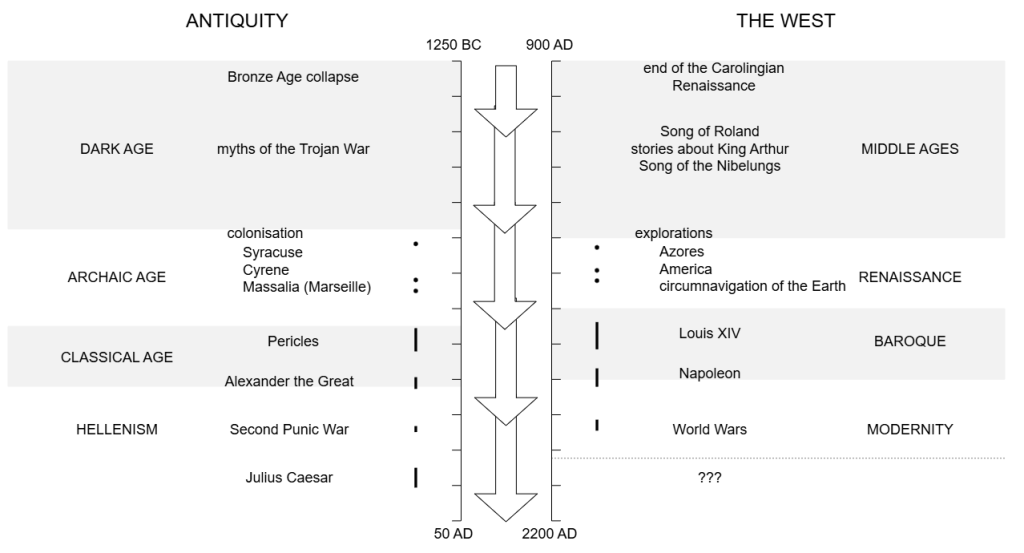
The timeline
The emergence of new animal species usually occurs in isolated places, with reduced populations, practically on the verge of extinction, because sexual reproduction is then unable to filter out appearance deviations. In light of this, we expect that periods of severe difficulties are found at the beginning of cultural genesis, when the norms of family formation are overturned and unusual forms of social behavior may be transmitted to the next generation.
In the initial period, the existing social order falters and then breaks up into small, local communities. This period is accompanied by the decline of those customs and techniques that we usually call the achievements of civilization. Writing, long-distance trade, state organization, science and philosophy are mostly lost. However, something else is born in their place: a deep, enthusiastic religiosity, to which a rich store of legends and tales about the world – an original mythology – is also created. These processes took place in the first half of the Greek Dark Age and the Western Middle Ages as shown in the diagram. In the second half of these periods, contact between small local communities is established, cities form, and the critical examination of religion and myths begins.
Since the people of the new culture are starting from scratch, these efforts of development begin in small steps, but about five centuries after the initial collapse, they lead to tangible results: the struggle starts to establish a new form of government, to improve the previously untouchable religion, and in most cases, geographical expansion is implied as well. Many of the most beautiful artistic works of the emerging culture come from this hopeful period – for example, the Antique Archaic Age or the Western Renaissance.
By the time of Classical Antiquity and the Baroque, the culture had already created its own, completely unique way of life and worldview, but at the same time these results were still under continuous development and improvement. Extremely deep and rich religious, artistic, and political traditions have already appeared on the scene, and these traditions are practiced and applied by cultured people with natural flexibility and elegance in the face of new challenges. They live in it like a fish in water. Emblematic events, personalities, genres, and achievements line up during this period: in addition to Pericles and Louis XIV shown in the figure, the Delian League and the Peace of Westphalia were also born at this time, the statues of Pheidias and the music of Mozart, the philosophy of Socrates and the physics of Newton. This is a period of comprehensive, extremely rapid, and often violent changes, in which things are nevertheless “in their place,” and the cultured person perceives the world as a coherent and meaningful whole regardless of joy and pain.
Compared to this four or five centuries of proliferation and the intoxication that results from it, the fulfillment of culture is disappointing. Changes slow down, become superficial and empty. We arrive at the age of world cities. The results previously won with blood and sweat are still available but the people – the now civilized people – are still dissatisfied because they perceive the impossibility of further development as obstacles arise in many directions. The great turning point for the West can be linked to the first French Revolution and Napoleon, while in the Antique world it is connected to the social upheaval that first raised the Macedonians of Alexander the Great and then Rome above all city states. Thus Modernity and Hellenism were ushered in.
Art at this time descends into the pursuit of short-lived fashion fads and the imitation of exotic, foreign creations. Practical utility becomes the main organizing principle of civilized life, which opens up previously unimaginable possibilities of organization and efficiency, often in conjunction with new technologies. At the same time, this practical orientation increasingly comes into conflict with tradition, and the conflict ends in long and cruel battles. This is a period of huge civil wars within civilization and terrifying foreign attacks, which, however, hardly change the essential characteristics of culture. Rome fought with Carthage and Macedonia, the invading Germanic tribes and the Parthians. On the part of the West, we found the world-conquering imperialism of the 19th century AD, the two World Wars, and the American and Soviet occupying forces left behind.
Limitations of the model
The formation of the West is now at precisely this stage of our description, in the middle of the era of fulfillment, and we do not know exactly what awaits it in the next few centuries (see the question marks in the lower right corner of the figure). After fitting the model, we may be able to make a prediction about this. On the other hand, any speculation about events after 2200 AD is moot. Morphological genesis is completed by then, and the finished culture takes its final form.
Of course, many events can occur after the end state is reached. Life did not cease in the Mediterranean area after the last Antique year marked in the figure (50 AD). In fact, the Roman state survived for a long time after that. However, we have reached the limit of the model of cultural genesis. From here on – as we see in the case of animal species – a period of stability follows, which will be ended at some later time – we do not know when – by the extinction of the culture. However, establishing the fact of extinction is not always self-evident, because such extinction events can again produce the deep social crisis in which a new culture can appear. Therefore, between the tangible 1200-1300-year formation periods, there are periods of irregular length and irregular course. In such cases, the morphological characterization of cultures is only suitable for describing their general traits rather than for predicting events in time.
In addition to temporal limitations, the model also has spatial limitations. Each culture has an ancestral homeland where it first appeared during a time of initial isolation and crisis. This area is obviously much smaller than the habitable surface of the Earth. Some cultures will expand later, for example, the West is now considered a reference point in almost every region of the Earth. However, it is very questionable whether a culture can play the same decisive role in the newly acquired territories as in its ancestral homeland. In light of this, predictions for the West cannot necessarily be considered valid for foreign places such as South Africa or even Russia.
- Essentially the same dilemma has arisen during the inspection of other social animal species. Do individual biological traits fully explain the functioning of an anthill? Certain behaviors—such as the self-sacrifice of some ants for the good of the community—lead scientists to hypothesize some kind of group evolution. However, such theories fail to demonstrate a principle similar to the mechanism of natural selection. ↩︎