
The theory of cultural morphology originates primarily from a German thinker named Oswald Spengler. Although others have dealt with similar historical models, the recognition of the relationship with biological theories – and thus the name of cultural morphology – is due to Spengler. To simplify things a little, we can also say that Spengler’s main work, “The Decline of the West”, presents the fitting of an organic model onto the data of universal human history. For Spengler, the basic phenomena of history – i.e. the parallel narratives – are the great cultures and civilizations of humanity. He attempted to make predictions based on the regularities discovered in the old stories of these cultures.
Contents
The great cultures
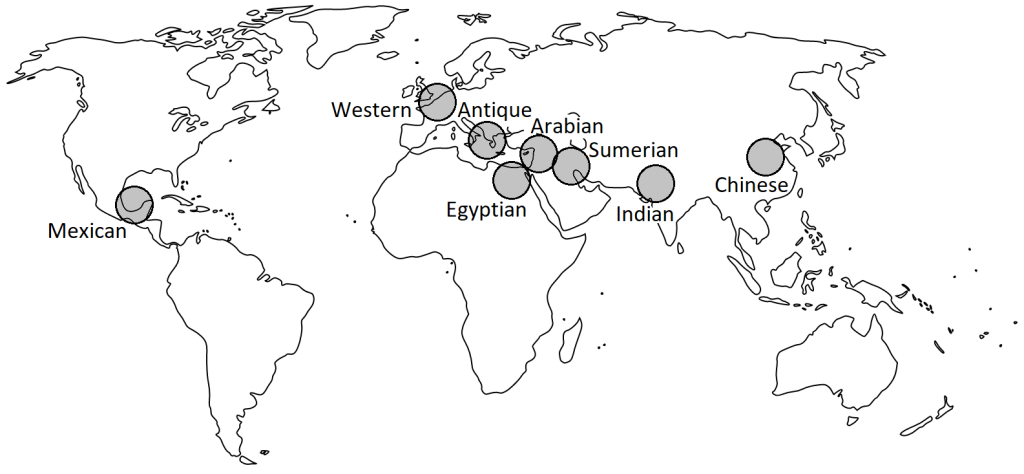
The locations of the eight great cultures examined by Spengler are shown on the world map of the first figure below. Mexican history in America, Egyptian history in Africa, and Western, Antique, Arabian, Sumerian, Indian, and Chinese histories in Eurasia constituted the data set to which Spengler adapted his model. The central territories of these cultures were of course not regular circles, and the markings on the map are only rough approximations. Nonetheless, it is clear that Spengler practically ignored a significant part of Earth’s habitable surface. For example, the entire Southern Hemisphere was left out of the investigation.
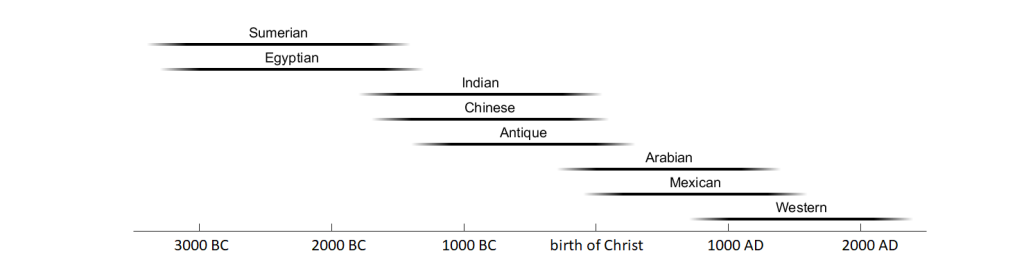
Furthermore, Spengler considered each culture to be worth studying only for a given period of time. These stories therefore have beginnings and ends. The second figure below gives a summary about the lifespans of individual cultures; this is again only approximate due to the uncertainty of the start and end dates. For example, Egypt is part of the model only until about 1600 BC. The high culture along the Nile was lost at that time, and any predictions about modern Egypt can only be made based on the influence of other cultures. Similarly, the Rhine Valley is also outside the validity of the model until about the 9th-10th century AD because this is when the story of the West, native to this region, begins.
Modeling principles
Although I have written in the introduction that Spengler fitted an organic model, this is really only true if “we simplify things a little”. “The Decline of the West” is mostly a poetic text in terms of its style and structure. Spengler assumed a coherent meaning behind many historical phenomena and works of art, which in places creates an esoteric effect similar to dream interpretation. Morphological concepts – such as analogy and homology – play important roles but they do not give rise to a comprehensive theory similar to biological evolution.1 Therefore, instead of an organic model, it is perhaps more correct to speak of a model containing organic elements.
Spengler did not write about the great cultures of humanity as phenomena comparable to animal species. Instead, he explicitly viewed these farming and city-building societies as individual living beings. These beings, in his view, were bound to different places on the earth’s surface, but belonged to the same species and accordingly went through similar life stages. The cultural genesis discussed on this website meant for Spengler the entire life of a culture from birth to death. He perceived death as the moment when the development of a culture stops and its form becomes final.
Spengler did not consider most of the spatial and temporal limitations of the model as shortcomings at all. In his eyes, true history consists exclusively of events occurring during the life course of great cultures. He considered events that did not fit into the biographies of great cultures to be purely biological phenomena that could have happened to ants. However, the eight cultures listed do not feature with equal weight in “The Decline of the West”. Besides the detailed parallels between the West and Antiquity, only Arabian-Byzantine history receives a more serious analysis, while the others are discussed to a much lesser extent or only from certain aspects. Moreover, in addition to these eight, there are plenty of other candidates that could be mentioned, which were probably left out of the list because Spengler did not know about them, or did not know enough about them. At the time of his writing, in Europe in the 1910s, it was not yet known that some of the ruined cities of the Indus Valley – such as Harappa or Mohenjo-daro – were contemporaries of the Egyptian and Sumerian cities, and that they were sites of an entire forgotten civilization. Presumably due to the lack of knowledge, the discussion of the Inca civilization that once existed on the slopes of the Andes in South America was also omitted.
The fact is, however, that the omission of some cases does not necessarily disprove the goodness and usefulness of a model. Two or three examples are enough to read a pattern, and eight, even with uneven knowledge, may be more than enough to give us an idea about the range of its validity. Finding more cases does not disprove anything in itself. Actually, finding such examples can be great news, because we can use them to test the model. Although the history of the Indus Valley Civilization took place thousands of years ago, this story is new in this respect. If we could get to know it in enough detail, this story could show how justified our expectations based on Spengler’s model – our “predictions” about the past – are. This way we would not necessarily have to wait for predictions about the future to decide the question.
Criticisms
Oswald Spengler has had plenty of opponents and critics over the decades, but they have rarely viewed Spengler’s work as a model to be examined only in comparison with other models. Instead, they have usually taken a stand by picking apart insignificant details or passionately rejecting his entire work.
The behavior of opponents and critics is partly explained by the way in which Spengler presented his message. We have already touched briefly, for example, on the fact that he took upon himself the right to decide what belongs to history and what does not. This is a small taste of the style of “The Decline of the West”. It is also worth recalling that the author compared his own work with noble simplicity to the Copernican revolution. Copernicus removed the Earth from the center of the universe and placed it among the planets while Spengler removed the West from the center of history and placed it among the great cultures. The parallel does not seem unworthy, but it is also certain that anyone who makes such a statement about himself can hardly be accused of modesty.
Of course, a certain amount of arrogance is forgivable and might be even necessary for the production of a work of this magnitude. If it were just a few grandiose or exaggerated statements, it would hardly detract from the impact of Spengler’s book. Unfortunately, however, that is not all.
One of the painful points that constantly invades our field of vision is that some of the author’s political views are clearly perceptible. Although he does not directly address the current politics of his age, in several places the pronounced German national feeling and the hope for a great national future are strongly shown. “The Decline of the West” was published after the First World War which was lost by the Germans, and in this critical state of mind it struck a chord that led to explosive success, mass sales and the growth of Spengler’s personal popularity and influence. While he had previously lived the life of a reclusive, lonely, sullen teacher, the book opened the doors of the social and cultural elite to him for a while. However, what was a blessing for those few years turned out to be a curse over the decades. The memory of Spengler’s Central European “conservative revolution” is overshadowed by the fact that the faltering Weimar Republic he criticized was followed by total oppression and war by the National Socialists. Although he cannot be directly accused of Nazism or anti-Semitism, his political activity makes him a very divisive figure, and this is also reflected in the treatment his historical work receives.
Another – perhaps even greater – burden is already evident in the title of the book: “The Decline of the West”. Those who have not read a single line of it often make judgments based on the title, and perhaps they make judgments the quickest and easiest. Based on the title, many people have thought and still think about current political issues, which in this case is a misunderstanding. We can know this precisely because Spengler himself stated that with the title “The Fulfillment of the West” – in addition to being just as appropriate to his message – he could have avoided many such misunderstandings.2
As the timelines in the second figure show, according to Spengler’s model, Western culture was indeed in its final stages of life when the book was published. Another century has passed since then. At the same time, these same timelines also reveal that the inevitable end will occur gradually over several generations. No one can expect the West to perish from one moment to the next. It’s a cruel joke of fate that the Western bloc that existed during the Cold War and, as its continuation, the Euro-Atlantic community today also likes to refer to itself as the West. These political actors and institutions came onto the scene decades after Spengler’s death, and although he managed to predict many of their characteristics, he could not have foreseen this resonance in the name. When he speaks of the West, he is not talking about the West as we know it in current politics, but about something much larger and more long-lived. Yes, the European Union and NATO have become important elements of Western civilization, but its fate does not depend on them at all, as it has already experienced the rise and fall of numerous interstate cooperations, peace systems, and military alliances.
The cultural morphological model discussed on this website speaks of fulfillment rather than decline in the contemporary West, the end result of which will be cultural stability rather than death. This takes into account Spengler’s warning, but not only that: the parallel of biological evolution also demands this interpretation.
- In Spengler’s time, knowledge of biological evolution was much more rudimentary than it is today, so his options in this regard were naturally limited. He considered the morphological observations of Goethe the German to be of inescapable importance, while he explicitly rejected the evolutionary ideas of Darwin the Englishman. These two theories had not yet come together into a common whole at that time. ↩︎
- The intended poetic effect was certainly the most important factor in the choice of the title. The usual English version do not even attempt to express the original German metaphor (“Der Untergang des Abendlandes”). To be fair, it is probably impossible to translate. ↩︎